

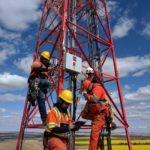


Fiber optic infrastructure anchors New England’s telecom network because you can carry terabits over low-loss, EMI-immune glass (ITU‑T G.652.D/G.657) across long, storm-exposed routes with fewer active field electronics than copper or coax. You engineer performance with optical budgets, splice-loss targets, connector reflectance, and dispersion limits, then verify it using OTDR traces and end-to-end insertion-loss tests. You also scale capacity by upgrading GPON/XGS-PON or coherent optics, rather than rebuilding the plant. Keep going to see where routes run and how builds get executed.
What Is Fiber Optic Infrastructure, Really?
At its core, fiber-optic infrastructure is the standards-based physical layer that transports data as modulated light through glass fibers, not electricity through copper wires. You deploy it as a hierarchy: backbone, metro rings, feeder, distribution, and drop, terminated on ODFs and patch panels and specified by ITU-T G.652/G.657 fiber, TIA-568 labeling, and Telcordia GR-20/GR-326 components. You engineer performance through optical budgets, splice-loss targets, connector reflectance, and dispersion limits, and then validate it with OTDR traces and end-to-end insertion-loss tests. You treat ducts, poles, and rights-of-way as constrained assets, so fiber economics and urban planning shape route diversity, handhole spacing, and resiliency. You also standardize on PON or point-to-point to match service models and growth.
How Fiber Networks Outperform Copper and Coax
Why does fiber consistently beat copper pairs and coaxial plant in real networks? You’re working with a medium engineered for low attenuation and high EMI immunity, so your plant meets tighter loss budgets and stays within spec longer. With ITU-T G.652.D and G.657 bend-insensitive standards, you can route drops and splices with predictable margins, even in dense New England builds. You’ll also cut active field electronics: fewer amplifiers, fewer powered nodes, and fewer corrosion-prone connectors than legacy coax and copper topologies. That reduces OPEX and improves MTBF, which is at the heart of fiber economics. During a coax migration, you can reuse ducts, poles, and handholes while upgrading optics at endpoints, rather than rebuilding the whole outside plant. That’s the innovation lever operators can actually measure.
Speed, Bandwidth, and Consistency With Fiber
How much throughput can your access and metro plant deliver when you stop fighting distance and noise? With fiber, you scale capacity by optics, not by rebuilding plant. Standards-based PON and coherent transport let you plan upgrades around ITU-T and IEEE roadmaps, keeping service levels consistent as demand spikes.
- Use GPON/XGS-PON to deliver predictable 2.5/1.25 to 10/10 Gb/s tiers.
- Add WDM wavelengths to multiply metro bandwidth without new ducts.
- Hold tighter power budgets and cleaner BER targets than legacy media.
- Normalize performance across longer spans with fewer active field elements.
- Align fiber economics with regulatory timelines by extending asset life and deferring overbuild.
You get deterministic headroom for cloud, AI edge, and multi-tenant backhaul, even during peak-hour saturation.
How Fiber Optic Infrastructure Reduces Latency
When you build on fiber, you cut latency by shortening signal travel paths through direct metro rings and fewer electrical regeneration points, reducing end-to-end propagation and processing delay. You also limit electromagnetic interference by transmitting as light in dielectric media, so you see lower noise pickup and more stable timing. With better optical signal integrity and standards-based synchronization (e.g., IEEE 1588 PTP), you’ll reduce jitter and keep packet delay variation within tighter bounds.
Shorter Signal Travel Paths
Across New England’s telecom backbone, latency drops fastest once you shorten the physical path a signal must traverse. You achieve this by engineering straighter fiber routes, reducing slack loops, and placing meet-me points closer to demand centers. Since light in fiber propagates at ~200,000 km/s, every extra 100 km adds ~0.5 ms one-way; route inflation quietly compounds round-trip delay. Don’t let fiber myths distract you: design geometry, not marketing, governs latency. As urban sprawl stretches service areas, you’ll need denser rings and more localized aggregation to keep paths tight.
- Map conduit to minimize route inflation
- Build metro rings with shorter chords
- Push edge PoPs nearer to users
- Standardize routing metrics in SLAs
- Verify path length via OTDR audits
Lower Interference And Jitter
Why does a fiber backbone stay stable even under heavy load? You’re moving photons, not electrons, so EMI from rail systems, coastal storms, and industrial motors can’t couple into the medium. That physical isolation delivers built-in Interference mitigation and keeps the signal-to-noise ratio predictable over long spans. With ITU-T G.652.D single-mode fiber, low attenuation and dispersion control reduce equalization overhead, so you sustain deterministic throughput as traffic scales.
You also cut packet delay variation. Fiber links support tight clock recovery (SyncE, IEEE 1588v2) and cleaner modulation performance, so buffers don’t oscillate under bursty demand. The result is measurable jitter reduction: steadier one-way delay, fewer retransmissions, and lower latency for voice, trading, and real-time edge apps across New England.
Why Fiber Optic Infrastructure Is More Reliable
You get higher network uptime with fiber because its optical signal is immune to EMI/RFI and stays within ITU-T/IEEE-compliant loss and dispersion budgets even through New England weather swings. You also maintain consistent performance, as low attenuation and stable optical SNR reduce bit errors and retransmissions over long spans. You maintain low-latency, low-noise end-to-end because passive glass links avoid crosstalk and electrical interference that can destabilize copper-based transport.
Weather-Resistant Signal Transmission
How does New England’s harsh weather affect uptime when the transport layer runs on fiber? You’ll see fewer storm-driven outages because glass is dielectric, so lightning-induced surges that trip copper plant don’t propagate along the medium. That built-in weather resilience helps you preserve signal integrity even through nor’easters, ice loading, and salt fog, especially when you specify OSP-rated cable and closures to Telcordia GR-20 and GR-771 and test per IEC 61300.
- Use armored, water-blocked OSP cable to limit moisture ingress
- Seal splice closures to GR-771 to prevent freeze–thaw leaks
- Enforce bend-radius limits to avoid microbending loss during wind sway
- Monitor OTDR baselines to spot weather-linked attenuation shifts
- Bond and ground metallic strength members per NEC for safer survivability
Low-Latency, Low-Noise Performance
Storm hardening keeps the glass intact, but fiber’s reliability shows up even more clearly in day-to-day performance: it delivers consistently low latency and low noise because the transport medium doesn’t couple to electromagnetic interference. That means your links don’t degrade in a noisy neighborhood near substations, rail lines, or dense 5G radios. In ITU-T G.652/G. 657-compliant plant, you preserve spectral purity across DWDM grids, so coherent optics hold higher-order modulation with fewer errors and less FEC overhead. You also gain predictable jitter budgets for VoIP, telemedicine, and edge compute, since dispersion and attenuation remain stable and measurable. With proactive OTDR and optical power monitoring, you enforce bandwidth safety: you detect drift early, avoid retransmits, and keep SLA latency targets achievable.
How Fiber Holds Up in New England Weather
In New England’s freeze–thaw cycles, coastal salt fog, and nor’easter wind loading, fiber performs reliably because the glass itself doesn’t corrode and carries no electrical current. You design for weather resilience by specifying sealed closures, gel-blocked or dry-core cables, and IEEE/GR-20/GR-409 compliant components, then validating with OTDR baselines after storms.
- You reduce lightning and ground-fault exposure versus copper.
- You limit water ingress using IP68-rated splice cases and tested gaskets.
- You manage ice-driven sag with proper strand tension and NESC clearance.
- You keep loss stable by enforcing the bend radius per TIA-568/ISO/IEC 11801.
- You improve fiber economics by cutting truck rolls through predictive monitoring.
You’ll meet tighter SLAs because attenuation drifts are measurable, not mysterious, even in subzero thaws.
Where New England’s Fiber Backbones Run
Where do New England’s fiber backbones actually run when you trace them on a map? You’ll see dense rings through Boston/Cambridge, Providence, Hartford, and New Haven, then long-haul spines paralleling I-95, I-90 (Mass Pike), I-91, and I-84 to interconnect metros and carrier hotels. From these routes, you’ll branch laterals to coastal landing areas and inland regeneration huts, keeping spans within optical budgets for coherent DWDM. You’ll also follow utility corridors and rail rights-of-way to minimize crossings and support diverse paths to meet resiliency targets (e.g., 99.99%+). As urban sprawl pushes demand outward, you’ll extend regional aggregation to Worcester, Lowell, Manchester, and Portland, feeding fiber backhaul into 5G hubs, data centers, and municipal networks.
Permits, Make-Ready, and Construction for Fiber Builds
How do you turn a fiber route on a GIS map into strand in the air or conduit in the ground? You translate design intent into compliant field work by sequencing permits, utility coordination, and construction packages to NEPA/local ROW rules and NESC clearances. You’ll reduce permit delays by submitting complete traffic control plans, pole attachment applications, and environmental notes aligned to municipal checklists. Then you manage make ready logistics with joint-use owners: survey poles, model loading, and schedule transfers before you hang or lash cable. You’ll enforce standards at every handoff, from OTDR baselines to as-builts. Focus on:
- Jurisdictional ROW and conservation sign-offs
- Pole survey, class, and clearance validation
- Make-ready notifications and outage windows
- HDD bore logs, duct proofing, and mandrel pulls
- Splice plans, labeling, and GIS as-built reconciliation
Cost and Timelines to Expand Fiber Optic Infrastructure
When you model fiber expansion in New England, your biggest budget drivers are route miles, pole vs. underground placement, make-ready scope, and electronics choices aligned to ITU-T and IEEE standards. You can’t compress timelines unless you account for permitting cycles and utility make-ready queues, which often set the critical path more than construction productivity. You’ll usually hit target ROI fastest by phasing builds—prioritizing high-demand corridors first, then extending to lower-density areas as take-rate and cost-per-passing metrics validate the next tranche.
Budget Drivers And Tradeoffs
Why does fiber expansion in New England so often run over budget or slip schedules? You’re balancing fiber economics against urban planning constraints, then choosing designs that meet IEEE/ITU performance targets without overspending. Unit costs swing with rock trenching, aerial versus underground mix, and splice density, while schedule risk tracks crew productivity and supply-chain lead times for cable, splitters, and optics. You can’t optimize every variable at once, so you trade capex, opex, and scalability.
- Choose higher-count cables to cut future overbuild, but raise upfront capex
- Densify handholes to reduce fault isolation time, but add materials and labor
- Standardize on bend-insensitive G.657 to ease routing, but pay premium pricing
- Push deeper FTTx to reduce opex, but increase drop complexity
- Target redundancy (diverse paths) to harden SLAs, but extend construction windows
Permitting And Make-Ready Timelines
Even after you’ve optimized cable count, splice density, and FTTx depth, permitting and make-ready work often sets the real critical path for fiber expansion in New England. You’ll face municipal right-of-way permits, conservation reviews, rail and highway crossings, and 811 dig-safe coordination, each with queue-dependent cycle times. For aerial routes, you must complete utility pole surveys, structural loading per NESC, and attachment applications aligned to FCC 1-Touch Make-Ready where available. When owners sequence work, you inherit their calendars, not yours. You can compress risk by standardizing submittal packages, GIS-based as-builts, and photo logs, and by pre-negotiating traffic control plans. Track intervals like application-to-issuance and make-ready-to-ready-to-attach; ignore any irrelevant topic or unrelated concept.
Phased Builds And ROI
How fast can you turn New England fiber miles into cash-flow-positive passings? You’ll hit predictable ROI timing when you stage builds by demand density, not by town lines. Model capex per passing, take-rate curves, and OPEX under MEF-aligned service definitions and IEEE optical budgets. Then sequence construction so early zones fund later miles—phased funding that keeps debt metrics tight and crews utilized. Track schedule risk with make-ready critical paths and unit-rate production data (ft/day, splice/hour). Your plan should lock to measurable gates:
- Priority clusters: >35 passings/mile, lowest cost per drop
- Standardized designs: 1:32 split, ITU-T compliant optics
- Construction sprints: 60–120 day zones to revenue
- Activation SLAs: <10 days from order to light
- KPI dashboard: take-rate, churn, ARPU, payback month
Why 5G Networks Need Fiber Backhaul
Across New England, 5G radio sites only deliver their promised multi‑gigabit throughput and low‑latency performance when they are anchored to fiber backhaul that meets stringent transport KPIs. You’re targeting 3GPP latency and availability budgets, and your fronthaul/backhaul must sustain synchronized, jitter‑controlled transport for massive MIMO and carrier aggregation. Microwave can’t always meet spectral constraints, fade margins, or scaling demands as sector bandwidths push past 1–10 Gb/s. With fiber optics, you provision 10/25/100GbE, support IEEE 1588v2 timing, and keep packet loss within SLA thresholds. You also improve backhaul economics: higher capacity per route‑mile, lower OPEX, and faster turn‑ups via standardized Ethernet/MPLS or segment routing. That’s how you future‑proof densification and edge compute.
Frequently Asked Questions
What Maintenance Does Fiber Require After Installation in New England Towns?
You’ll do minimal routine work, but you must run disciplined maintenance schedules in New England towns. Inspect aerial and underground routes after nor’easters, freeze–thaw cycles, and roadwork; verify clearances, handholes, and seals. Perform periodic fiber testing (OTDR, OLTS) to baseline loss, detect microbends, water ingress, and connector contamination. Clean and scope connectors per IEC 61300-3-35. Track results in GIS/CMMS, trigger dispatch on threshold drift.
Can Homeowners Request Fiber Extensions to Rural Properties or Private Roads?
Yes—you can request homeowner extensions to rural properties or along private roads, but you’ll need the provider’s engineering review and cost share; it’s like building a bridge to your driveway. You submit a serviceability ticket, easement proof, and right-of-way permissions. They’ll model splice loss budgets, pole loading, and conduit specs to meet ANSI/TIA and NEC requirements. You’ll often pay make-ready, trenching, and construction fees.
How Do Providers Handle Fiber Outages and Restoration Priorities During Storms?
During storms, you’ll see providers run storm response playbooks that prioritize outage restoration by impact: safety, 911 backhaul, hospitals, and dense feeder cuts before single drops. You’ll get triage via OTDR traces, GIS outage clustering, and SCADA/power alarms, and then crews will be dispatched under NIMS/ICS protocols. They’ll deploy temporary aerial spans, portable generators, and spare closures, then schedule permanent splices once access and pole permits are cleared.
What Are Typical Installation Impacts on Landscaping, Driveways, and Sidewalks?
Wondering how much disruption you’ll really see? You’ll typically face narrow trenching or directional boring; crews restore topsoil and reseed, yet minor landscaping damage can occur. Driveways and sidewalks usually get bored under to avoid cuts; if saw-cutting’s required, patching follows DOT specs and compaction targets. You’ll need installation permits and utility locates before any dig. Expect 1–3 days onsite, plus cure time for concrete or asphalt. Rehab inspections verify restoration.
Are There Environmental or Health Concerns Associated With Fiber Optic Cables?
You’ll face minimal environmental or health concerns with fiber optic cables because they’re passive glass strands that don’t emit RF energy. You should focus on environmental ethics: specify RoHS/REACH-compliant materials, low-toxicity jacketing, and responsible trenching to protect soils and waterways. You won’t get harmful emissions during operation; impacts are concentrated in manufacturing and diesel-powered construction. You can mitigate by requiring EPDs, recycling take-back, and ISO 14001 suppliers.
Conclusion
You’ve seen that fiber optic infrastructure is New England’s telecom spine: glass strands carrying terabits like light through a clear river. Compared with copper and coax, you get lower attenuation, higher SNR, and predictable throughput under IEEE/ITU-T specs. You’ll cut round-trip latency with cleaner optical paths and fewer active hops, and you’ll gain uptime through immunity to EMI and corrosion. As permits clear and make-ready finishes, you’re also laying the essential backhaul 5G can’t live without.


