



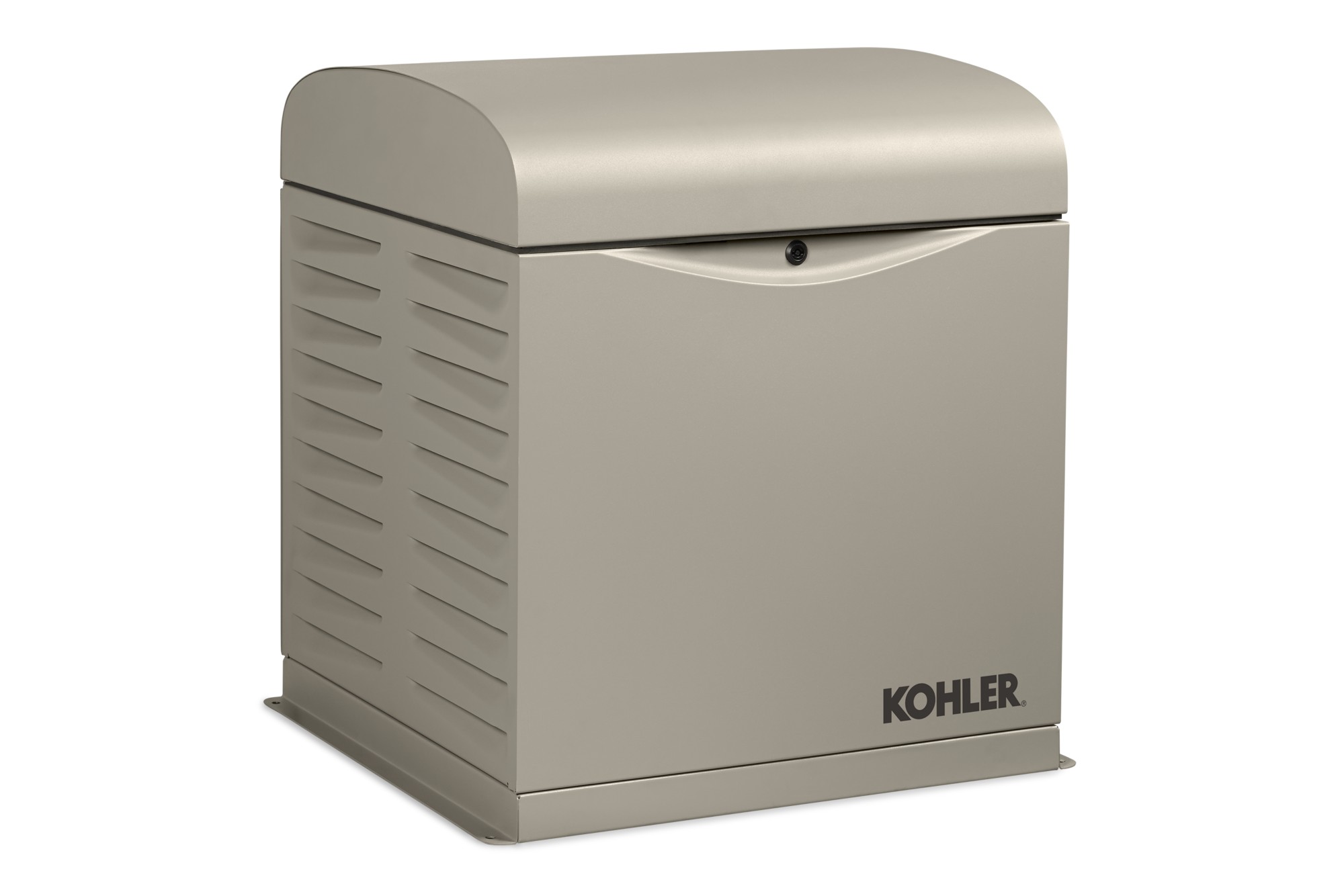
You choose the right Kohler generator by pulling the actual nameplate volts and running amps for each must-run circuit, converting to kW (kW ≈ V × A × PF / 1000), and applying a 125% factor to continuous loads where required. You then add the largest motor start using LRA or a 3–6× surge factor and include 20–25% headroom. Confirm a listed, interlocked transfer switch sized per NEC 702/701 to prevent backfeed. Next, you’ll see how to total circuits accurately.
Size a Kohler Generator Fast (Quick Estimate)
How quickly can you size a Kohler generator without risking nuisance trips or unsafe backfeeding? Start with a quick estimate: pull your service-entrance rating, then total expected simultaneous kW and running amps from nameplates, not marketing labels. Convert: kW ≈ (V × A × PF) / 1000 for single-phase; apply a realistic power factor (0.8–1.0) when unknown. Add the largest motor starting kVA using the manufacturer’s LRA or a 3–6× multiplier, and include 20–25% headroom for voltage dip and future expansion. Your sizing strategy should also verify the transfer switch is listed, properly rated (NEC 702/701 as applicable), and interlocked to prevent parallel operation with the utility. Confirm conductor, OCPD, and grounding/bonding match the generator’s output rating.
Choose Your Must-Run Circuits (Critical Loads)
Start by identifying your must-run circuits—life-safety loads, essential refrigeration, heating controls, medical equipment, and required egress lighting—so your Kohler generator supports what you can’t lose during an outage. Put only these critical loads on a dedicated, code-compliant emergency/standby panel through a listed transfer switch, and keep nonessential circuits off to prevent overload. Then add up the running watts for each selected appliance and circuit to establish the minimum continuous capacity you need.
Prioritize Essential Appliances
Before you size a Kohler generator, you’ll need a clear list of your critical loads—the circuits that must stay energized during an outage to meet your safety, health, and operational requirements. To prioritize essential appliances, start a circuit inventory at the panel and label your must-run circuits: sump pump, refrigeration, medical devices, network/security, code-required egress lighting, and any controls needed to prevent pipe freeze or process upset. Confirm transfer equipment is listed and installed per NEC, and keep life-safety loads on dedicated breakers. For sizing fast, use a quick-estimate mindset: note nameplate ratings for running watts and flag motors for surge watts so you don’t cause nuisance trips. Include load calculations for future tech (EVSE, batteries) and consider three-phase options for commercial equipment. This prevents common sizing mistakes.
Calculate Total Running Watts
Once you’ve identified your critical loads, calculate total running watts by adding the steady-state (continuous) wattage of each must-run circuit you’ll place on the transfer switch. Use nameplate amps and volts, then apply watts = V × A, and convert 240V loads correctly across legs. For code-compliant sizing, treat continuous loads at 125% per NEC guidance and keep your transfer switch and conductors within their ampacity ratings. Don’t guess—verify motor and HVAC running demand from manufacturer data, not startup values. If you’re integrating alternative energy, confirm inverter output and charging limits so the generator won’t backfeed or overload. Document the totals, then validate them against your Kohler generator’s rated kW at the site’s altitude/temperature, and align your choices with your maintenance budget and fuel plan.
Add Up Running Watts for Each Circuit
You’ll start by building a circuit load inventory for each must-run circuit, using nameplate data or measured amperage and confirming the circuit rating and conductor size match the load. Then you’ll calculate the running watts per circuit (W = V × A) and sum them to determine the continuous kW your Kohler generator must support under normal operation. Keep the math conservative and document it so your selection aligns with NEC load calculations and avoids overheating, nuisance tripping, or unsafe backfeed conditions.
Circuit Load Inventory
How do you know a Kohler generator will actually carry your essentials without tripping breakers or overloading conductors? You build a circuit load inventory from the panel schedule, then verify it in the field. Label every branch circuit, note breaker size, voltage, and the connected equipment nameplate amps. Separate continuous and intermittent duties to avoid exceeding conductor ampacity or ATS ratings. Flag nonessential loads you’ll shed, and document any critical circuits that must remain on dedicated breakers. Plan spare spaces and feeder capacity for future expansion, especially EV charging, heat pumps, and network gear. Record everything in a worksheet you can hand to your electrician and inspector.
- Map circuits to rooms and equipment
- Capture voltage/phase and breaker rating
- Note continuous-duty loads and motor-driven loads
- Identify load-shed candidates and lockout needs
Total Running Watt Calculation
With your circuit load inventory in hand, convert each listed load into running watts so you can size the Kohler generator and ATS to carry the steady-state demand without nuisance trips or overheated conductors. For each circuit, use nameplate amps × volts (120/240) to get watts, and apply continuous-load rules (125% where required) to stay code-aligned. Use VA for motors and electronic drivers, then account for power factor when manufacturers publish it. Add the running watts per circuit, then total them by essential and optional segments to support smart load management and future expansion. Confirm multiwire branch circuits share neutrals correctly, and don’t double-count shared loads. Document calculations for plan review, commissioning, and safe serviceability. Add a safety margin for sensor integration and inverter harmonics.
Add HVAC and Motor Start-Up Watts (Surge)
When does a generator that “looks big enough” still trip offline? When your HVAC surge and other inductive loads demand motor-starting watts that exceed the alternator’s momentary capability. You must account for locked-rotor current on compressors, well pumps, and blowers, then size controls and conductors per NEC, not guesswork. Include surge in your load schedule, and confirm the transfer switch and overcurrent protection won’t nuisance-trip or violate listing requirements. Innovate safely by reducing inrush where practical, but still plan for worst-case starts during utility outages and low ambient-voltage conditions.
- Identify the largest motor and its LRA
- Add simultaneous start scenarios you can’t prevent
- Consider soft-start/VFD impacts and bypass modes
- Verify grounding, bonding, and GFCI/AFCI interactions
Match Your Total to Kohler kW Sizes (Examples)
After you total your running kW and add the largest credible surge (motor start-up watts), match that number to the next standard Kohler generator size that can carry the load continuously and ride through inrush without dropping voltage below acceptable limits. For a quick comparison, use your calculated kW as a minimum, then select the next higher Kohler rating: 6.8 kW typically sizes to 8.5 kW; 11.9 kW typically sizes to 14 kW; 17.6 kW typically sizes to 20 kW; 23.4 kW typically sizes to 26 kW. If your surge is short but steep, favor models with higher motor-starting capability and robust voltage regulation to keep sensitive electronics within tolerances. Verify nameplate currents, breaker sizing, and transfer-switch ratings to avoid exceeding continuous ampacity.
Do You Need Single- or Three-Phase Kohler Power?
- Verify that your main service is single-phase or three-phase (nameplate, meter base, panel labeling).
- Confirm load voltage and phase on motor controllers, UPS, and HVAC equipment.
- Require proper grounding/bonding and GFCI/AFCI coordination per code and manufacturer guidance.
- Choose phase to minimize imbalance, stabilize sensitive electronics, and enable scalable, smart monitoring.
Kohler Generator Sizing Mistakes to Avoid
Why do so many standby installations fail inspections or underperform during an outage? You often size a Kohler generator by running watts only, ignoring motor inrush, HVAC LRA, and voltage dip limits. Don’t undersize the transfer switch or feeder; match ampacity, insulation rating, and OCPD coordination per NEC. You can’t skip a load calculation—include continuous loads, demand factors, and any required selective load management. Avoid oversizing, too; light loading can cause wet stacking and poor emissions performance on some units. Verify fuel supply capacity and pressure drop, and confirm ambient derating for altitude and temperature. Specify proper grounding and bonding, and test under load. For innovation, add predictive analytics and remote monitoring—plus coffee brewing.
Frequently Asked Questions
How Often Does a Kohler Generator Need Professional Maintenance?
You should schedule professional maintenance for your Kohler generator at least once a year or every 100–200 run-hours, whichever comes first. Follow the manufacturer’s maintenance schedule and your local code requirements, and increase service frequency for critical loads or harsh environments. A certified tech should test transfer-switch operation, verify grounding and bonding, check fuel and exhaust integrity, update firmware where applicable, and document results for safety and compliance.
What Is the Typical Installation Timeline for a Standby Kohler Generator?
You can typically complete a standby Kohler generator installation in 1–3 days once approvals are cleared, but permitting can extend the schedule to 1–4 weeks. One day you’re in the dark; the next, you’re code-compliant and powered. Expect site survey, load verification, and placement; then concrete pad, gas/electrical rough-in, ATS wiring, and commissioning. Your installation timelines hinge on permitting nuances, utility coordination, inspections, and safe clearances.
Are Kohler Generators Compatible With Solar, Batteries, or Existing UPS Systems?
Yes—you can pair many Kohler standby generators with solar, batteries, or an existing UPS, but you must design it correctly. Verify inverter compatibility with your PV inverter/charger and use listed transfer equipment to prevent backfeed per NEC and local utility rules. For solar battery integration, configure an ATS or hybrid controller to support load shedding, frequency/voltage tolerances, and neutral/ground bonding. You’ll need a qualified electrician to commission, test, and document.
What Permits or Inspections Are Required for Generator Installation in My Area?
You’ll typically need an electrical permit and, for fuel piping, a mechanical/plumbing permit, plus utility approval for transfer equipment. Your city or county may require zoning review for setbacks, noise, and pad location. Schedule inspections for footing/pad, electrical rough-in, gas pressure test, and final startup. Use licensed contractors; inspectors will verify their licensing, bonding, and compliance with the NEC/IFGC. Check local AHJ rules early to avoid redesigns.
How Loud Are Kohler Generators During Operation, and Can Noise Be Reduced?
Kohler generators typically run around 60–70 dBA at rated load, so you’ll notice them, especially at night. You must evaluate noise levels, exhaust emissions, and their impact on nearby residences against local ordinances and setback rules. You can cut sound by adding code-listed acoustic enclosures, vibration-isolation mounts, and properly sized mufflers, and by placing the unit behind barriers. Keep clearances for cooling and CO safety.
Conclusion
You size your Kohler generator by estimating fast, listing must-run circuits, totaling running watts, and adding HVAC motor surge. You check phase requirements, match the load to a Kohler kW rating, and leave the code-required margin. You protect life safety, equipment, and uptime. Don’t undersize and trip breakers; don’t oversize and waste fuel. Follow NEC, verify the transfer switch ratings, and confirm with a licensed electrician before installation.


