
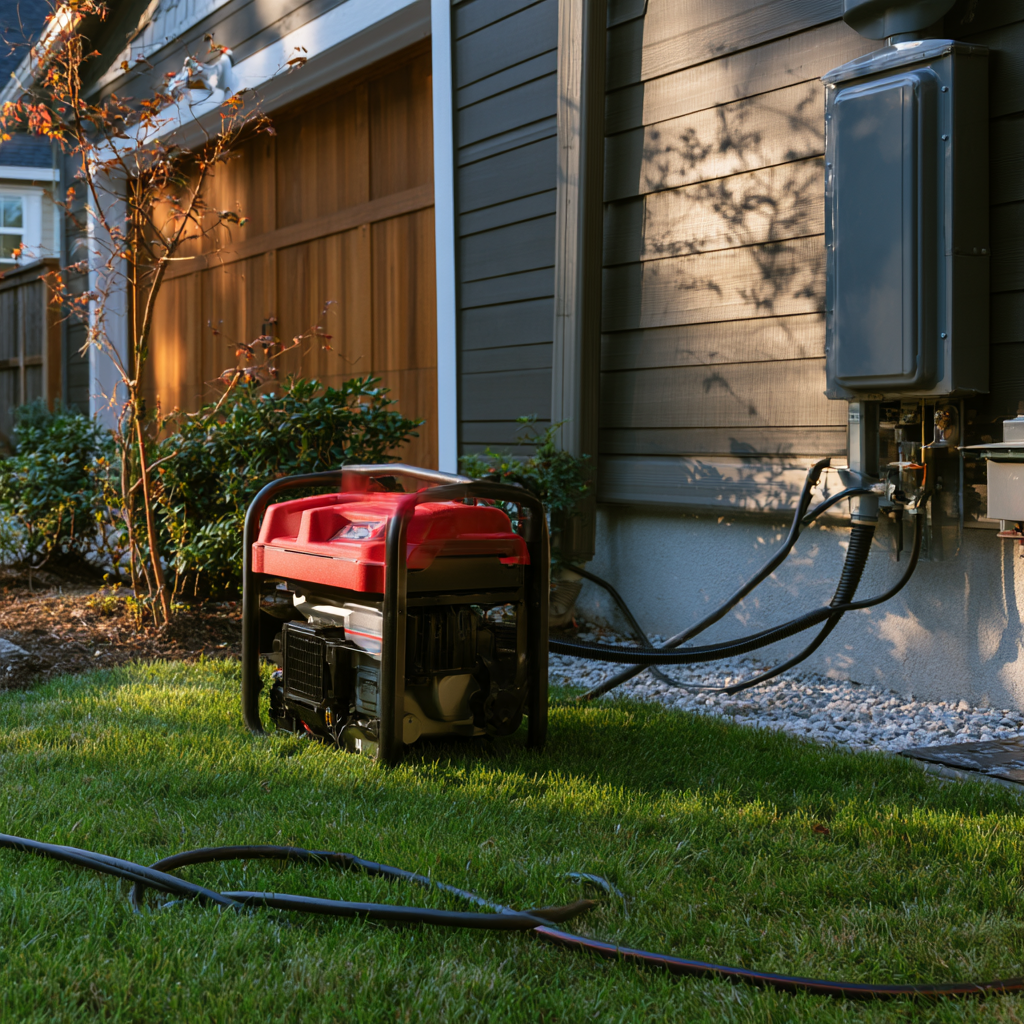
Many New Hampshire homeowners already own a portable generator. The question is how to use it to power the furnace, well pump and fridge without running extension cords all over the house, and without putting anyone in danger.
The answer is a properly installed transfer switch or generator interlock kit. Here’s how they compare.
First: never “backfeed” your house
Some people connect a generator by plugging a homemade double-male cord into a dryer outlet or wall outlet. Don’t do this. This is called backfeeding, and it can kill.
Without proper isolation, your generator’s power can travel back out through your service and the utility transformer onto the lines on your street. According to Maryland’s Department of Emergency Management, this puts first responders, utility workers and neighbors at risk of electrocution. It can also destroy your generator when grid power comes back.
The safe way is a code-compliant transfer device installed by a licensed electrician.
Option 1: Manual transfer switch
A manual transfer switch is a small subpanel installed next to your main panel. It’s wired to the circuits you choose, usually 6 to 10 essentials like the furnace, well pump, sump pump, refrigerator and a few lights.
Pros: Simple to use, keeps essential circuits clearly organized, and makes it hard to overload the generator.
Cons: Limited to the pre-selected circuits, and more labor to install.
Option 2: Generator interlock kit
An interlock kit is a sliding plate mounted on your existing main panel. It physically prevents the main breaker and the generator breaker from being on at the same time. A licensed electrician installs it with a generator inlet box on the outside of your house.
Pros: Often less expensive. You can power any circuit in the panel, choosing what to run as needed.
Cons: You have to manage the load yourself, turning breakers off and on so you don’t overload the generator. The kit must be listed for your specific panel.
Option 3: Automatic transfer switch and standby generator
If you’re tired of hauling a generator out in the snow, refueling it at 2 a.m. and running cords to an inlet, a permanent Kohler standby generator with an automatic transfer switch handles everything on its own. Power fails, the generator starts, and your home switches over, with nobody going outside.
Quick comparison
| Manual transfer switch | Interlock kit | Standby generator + ATS | |
|---|---|---|---|
| Works with portable generator | Yes | Yes | No (permanent unit) |
| Circuits powered | Pre-selected | Any, managed by you | Selected or whole home |
| Starts automatically | No | No | Yes |
| Relative cost | Moderate | Lowest | Highest |
| Best for | Simplicity | Flexibility on a budget | Hands-off reliability |
Portable generator safety still applies
Whatever hookup you choose, the generator itself always stays outside, away from windows, doors and vents. The CPSC warns that one portable generator can produce as much carbon monoxide as hundreds of cars. Never run it in a garage, even with the door open. Make sure your home has working CO alarms.
Is your panel compatible?
Interlock kits must match your panel’s make and model, and older or full panels may not have room. If yours isn’t compatible, an electrical panel upgrade can solve that and prepare your home for future loads at the same time.
Get set up before the next outage
TMB Electric installs generator inlets, interlock kits and transfer switches throughout southern New Hampshire, and we pull the permits so the work is done to code. Request a generator hookup quote today. If storm damage has already hit your service, our 24/7 emergency team is ready.